Rankings and reputation used to be enough. They no longer are. Prospective students, and the parents and counsellors advising them, want a sharper answer: where does this exact degree lead, and for whom?
Data-driven, employment-focused student recruitment means recruiting students with evidence of what graduates actually did next: their employers, industries, roles and salaries. It replaces broad claims about “strong employability” with data tied to each degree.
Students and parents no longer choose a university on rankings, reputation, or destination alone. They want to know:
Career pathways
How different study options may relate to future career pathways.
Growing industries
Which industries are growing, and where skills are in demand.
Employer expectations
How employer expectations are changing.
Destination & study choice
How destination and study choices can influence graduate opportunities.
Staying competitive
What graduates need to do to remain competitive in an evolving workforce.
The question every prospective student asks
Every student asks one question: where could this degree take my career and my earning potential? A prospectus or a league table position cannot answer that. Real outcomes data, at scale, can.
International and domestic recruitment is moving this way. The approach rests on three foundations: data, trust and transparency.
1. Data: move from claims to evidence
Universities already hold a large body of evidence in their alumni’s career journeys. Where did graduates work? Which employers hired them? Which industries did they enter? What jobs do they hold five or ten years after graduation? What do they earn? How do outcomes differ by degree, nationality, destination, and career stage?
The opportunity is to connect this evidence to recruitment. Instead of telling a prospective student that a programme offers “excellent career opportunities,” show them what graduates from that specific programme actually went on to do.
2. Trust: prospective students want proof, not promises
International education is a major financial and life decision. Students may spend tens of thousands of dollars, move countries and study for several years. They want evidence.
A ranking tells a student something about the institution. Alumni employment data tells them something about their possible future.
A prospective finance student does not only want to know where a university ranks. They want to know: which companies employ graduates from this degree, what industries they enter, what roles they progress into, where in the world they work, and what their earning potential might look like.
3. Transparency: make employment outcomes part of recruitment
Universities have traditionally published employment statistics at a relatively high level. There is a big difference between saying “our graduates have strong employment outcomes” and allowing a prospective student to explore “what happened to people who studied the exact degree I am considering.”
That is transparency. Some universities are now doing it.
Two universities putting this into practice
Cturtle built CourseAdvisor, a searchable alumni-outcomes platform, for two UK universities. Each links real graduate career data to individual degree programmes.
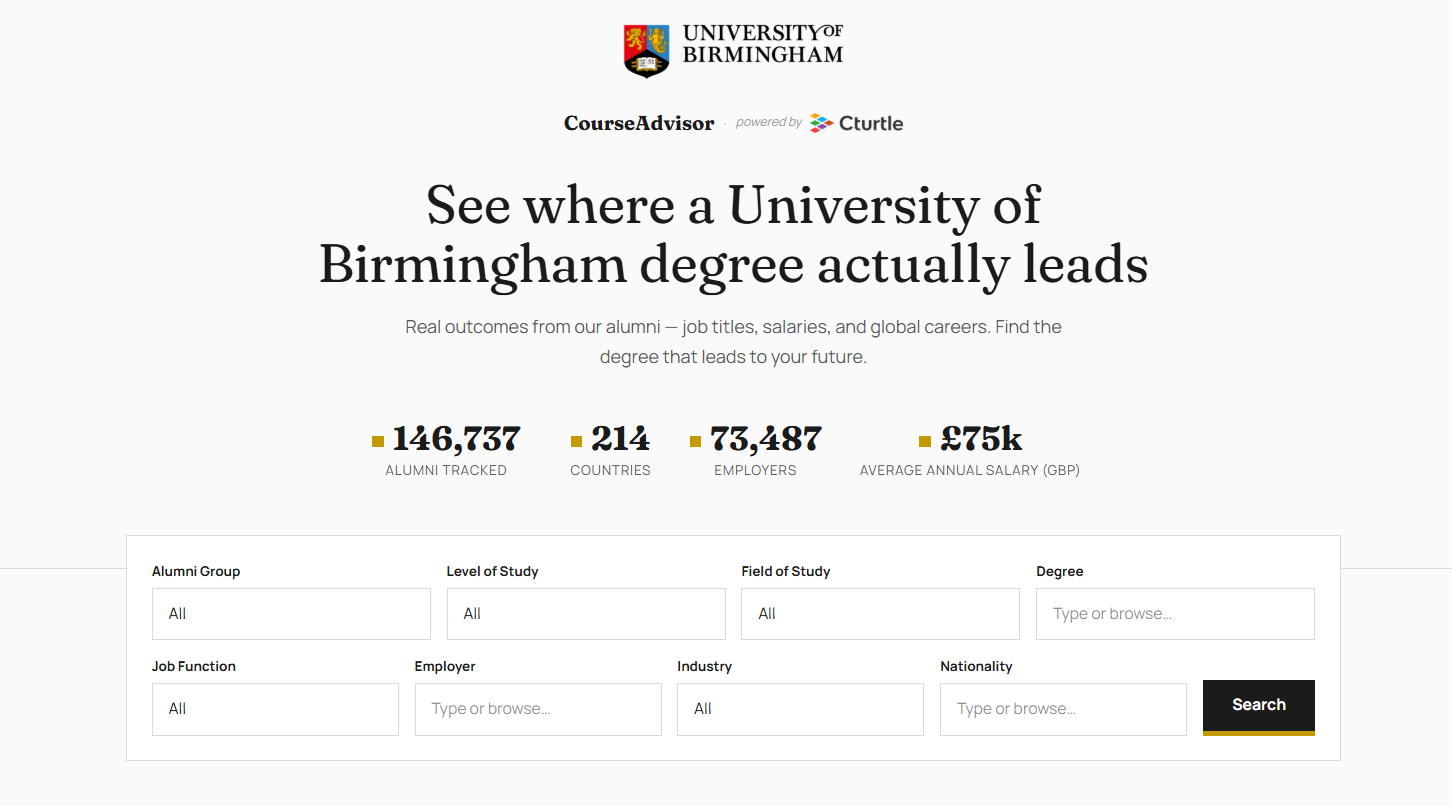
University of Birmingham. CourseAdvisor connects 289 degree programmes with 146,737 tracked alumni outcomes across 214 countries and 73,487 employers. Students can explore careers, employers, industries, salaries, and geographic outcomes before moving into Birmingham’s own course and enquiry pages.
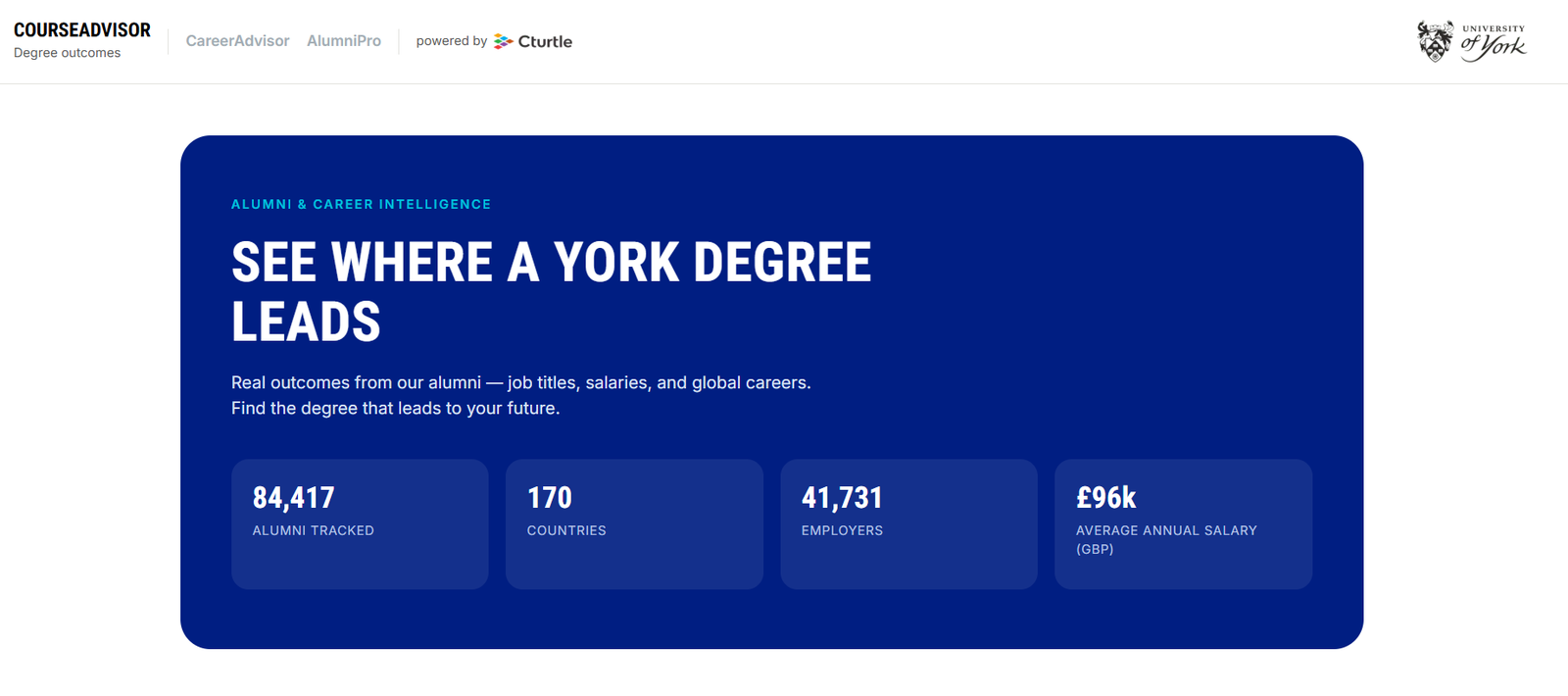
University of York. York’s CourseAdvisor connects 301 degree programmes with outcomes from 84,417 alumni across 170 countries and 41,731 employers. It is built to help prospective students “see where a York degree leads,” with job titles, salaries and global careers.
The aim is the same in both: put real career evidence next to the information students already use to choose where and what to study.
What this looks like for one degree
The data works at the level of a single degree. A student considering Economics at York can see how many alumni are tracked, their average salary and salary band, their top employers and job titles, and their estimated regional origin.
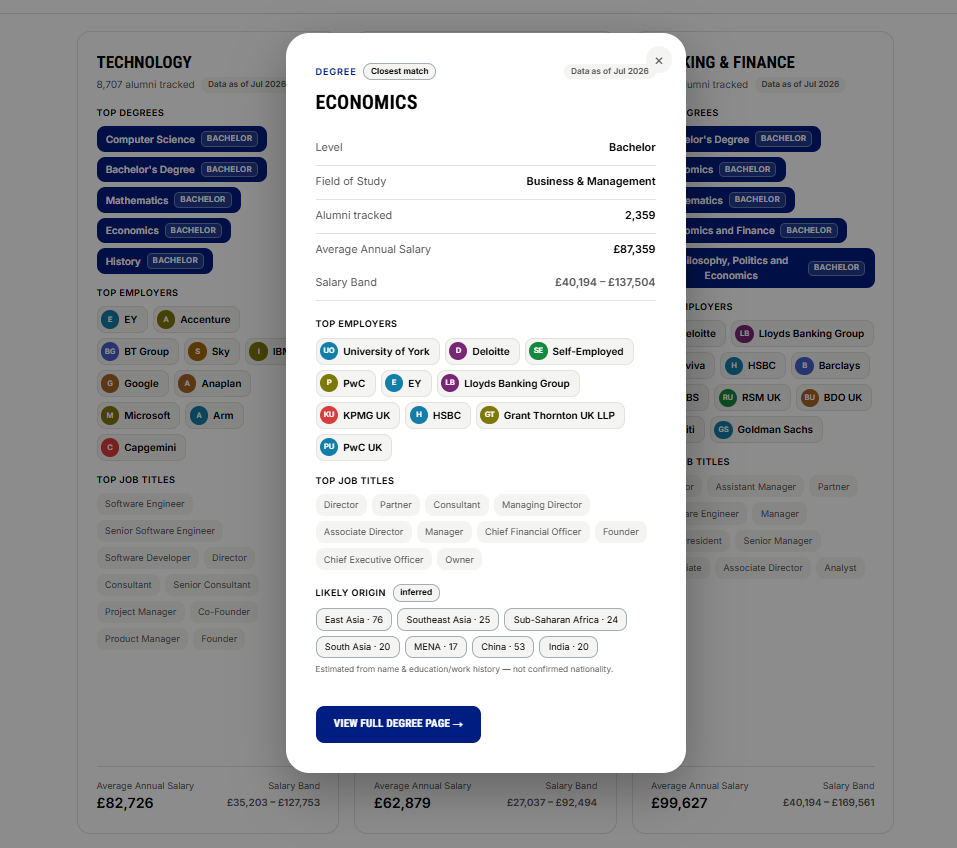
Every result links back to the university’s own course and enquiry pages, so a student researching outcomes stays within the university’s own recruitment journey.
Recruitment teams need new tools
This changes what we should expect from international recruitment teams.
Imagine a prospective student in India asking: “If I study this Master’s degree, which employers could I work for and what could I earn?” Or a parent in China asking: “Where are graduates from this programme working five years later?” Or a student in the Middle East asking: “Which degree gives me the strongest pathway into banking?”
Historically, even an excellent recruitment counsellor might struggle to answer those questions with institution-specific evidence. With alumni employment data connected directly to individual programmes, they can, at scale and worldwide.
Outcomes-focused counselling is the next step
Recruitment becomes more advisory. Rather than only helping a student choose a university or course, recruitment teams can increasingly help students understand the relationship between:
Degree
Skills
Industry
Employer
Career
Earnings
That is a more useful conversation. It is also where recruitment and employability meet. The same underlying alumni and labour-market intelligence used to attract prospective students can help current students understand employers, help graduates navigate careers, and help alumni teams understand their global community.
Rankings will not disappear. But outcomes will matter more.
This approach does not make rankings, brand or student experience irrelevant. They remain important signals.
But universities can now add something more tangible: evidence. For institutions competing globally, the question will increasingly be: can your recruitment teams show a prospective student — with real data — where each of your degrees could take their career and earnings?
Universities that can answer that question openly will be better placed to earn student trust. Marketing claims alone will not be enough. Outcomes will count.
Common questions
What is data-driven, employment-focused student recruitment?
An approach to recruitment built on real graduate career and salary outcomes, not rankings or reputation alone. It shows where a degree has led the people who studied it before.
How is the alumni outcome data verified?
Every alumni profile is cross-matched against Cturtle’s global employer and salary database, giving each tracked graduate a verified employer, industry and salary estimate, not just a job title from a public profile.
Does this replace a university’s own course pages?
No. Every CourseAdvisor search links back to the university’s own course and enquiry pages, so outcomes data and admissions stay in one place.
Which universities use this approach today?
The University of Birmingham (289 programmes, 146,737 alumni) and the University of York (301 programmes, 84,417 alumni) both use CourseAdvisor.
See CourseAdvisor for yourself
Explore real alumni outcomes at the University of Birmingham and the University of York, live.